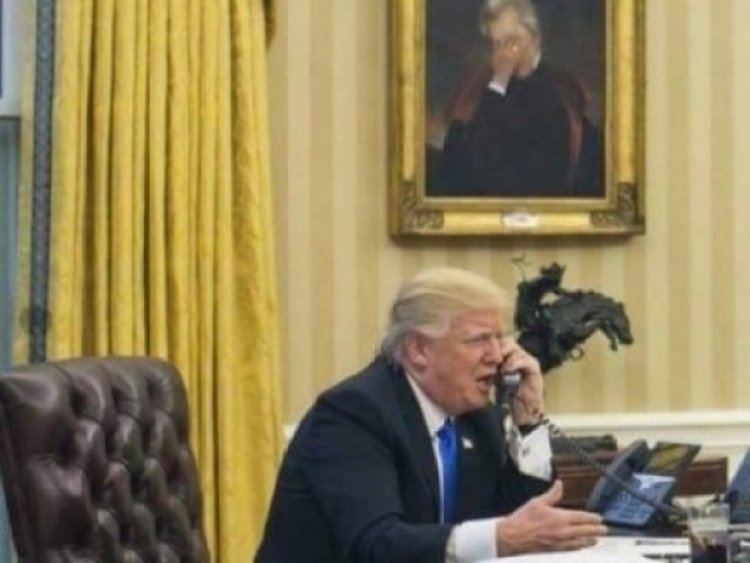
The deal was hatched after a chinwag with Nvidia chief executive Jensen Huang at the newly demolished White House building site.
Trump wrote on Truth Social that he had informed President Xi that the US would allow Nvidia to ship H200 products to approved customers in China and elsewhere, subject to conditions that maintain national security. He added that “25 per cent will be paid to the United States of America.”
The decision gives Nvidia a significant boost as it scrambles to stay in the world’s second-largest economy. It had earlier agreed to hand the US 15 per cent of China sales from its weaker H20 chip, only for Beijing to bin the deal during testy trade talks.
Nvidia’s silicon has become a geopolitical bargaining chip. The H200 outperforms the H20 that Nvidia was previously allowed to flog, although it lags behind the company’s top Blackwell kit launched this year and the Rubin generation due next year.
The approval followed Trump’s meeting with Nvidia chief executive Jensen Huang last week, where the pair discussed H200 exports, according to people familiar with the talks. Nvidia shares climbed nearly two per cent after hours.
Even with Washington taking a slice, the plan could be worth billions in sales for Nvidia, which enjoys fat margins on its artificial intelligence chips. In its latest fiscal quarter, Nvidia reported gross margins of 73.4 per cent on $57 billion in sales.
In August, Nvidia chief financial officer Colette Kress said that “if geopolitical issues subside” the outfit could ship between $2 billion and $5 billion of chips to China per quarter which could rise if orders increase.
Chinese tech giants that have struggled to get top-end chips to train their models may now get relief. Huang has long argued that Nvidia should be allowed to compete in China because the country has many of the world’s best AI researchers, and the US should want them to use American technology.
Huang also made clear that the scale of Chinese AI demand is vital for Nvidia’s future. “You’re not going to replace China,” Huang said at a CSIS event last week.
Trump promised to apply the same approach to exports from AMD and Troubled Chipzilla, in which the government owns a ten per cent stake after converting billions in grants into equity earlier this year. Chipzilla is not a major exporter of high-end AI parts.
The green light came only weeks after senior officials, including Secretary of State Marco Rubio, blocked Nvidia’s attempt to sell a slimmed-down Blackwell chip to China ahead of a meeting between Trump and Xi Jinping.
Some officials, including AI czar David Sacks and commerce secretary Howard Lutnick, backed shipping the H200 because it offered a compromise that let Nvidia compete with China’s Huawei Technologies without pushing China past the US in AI development, people familiar with the discussions said.
After H20 exports were approved earlier this year, China told its firms not to use the chips, citing security concerns. However, analysts reckoned it was a negotiating ploy to secure a better part, such as the H200.
Nvidia has been lobbying hard across Washington this year, arguing that selling its prized chips globally will secure US tech dominance, although this irritated officials who feel the company puts a sales bonanza ahead of national security.
Former White House technology and security official Aaron Bartnick, now at Columbia University, said: “This decision to authorise H200 sales to China is so shortsighted”, adding he believes it will significantly advance China’s chip efforts. At the same time, the US gets little in return for allowing exports. Bartnick said.
On Monday, the Justice Department revealed a sweeping crackdown on the smuggling of Nvidia chips, including the newly legal H200.
The government said Houston businessman Alan Hao Hsu had pleaded guilty to smuggling more than $160 million (€150 million) worth of Nvidia H100 and H200 parts, which officials said “are used for civilian and military applications.”
Officers also arrested two Chinese businessmen living in the US and Canada, charging them with violating export control laws by sending banned Nvidia GPUs to China through Hong Kong using falsified labels.
The prosecutions show how harshly smugglers of Nvidia’s AI hardware were treated while the old export rules were still in force.